
.avif)
Cannabis Rescheduling 2026: What Schedule III Actually Means for Medical Marijuana
On April 23, 2026, the U.S. Department of Justice made a major announcement: cannabis moved from being treated like heroin (Schedule I) to being treated more like prescription painkillers (Schedule III), effective April 28. As an Arkansas medical marijuana dispensary, we've been tracking this closely because it directly affects our patients and the industry we operate in. This is a real change — but before you celebrate, here's what it actually means, what it doesn't, and why a hearing on June 29 matters.
Our CEO, Amanda Strickland, was recently interviewed by MJBiz Daily — the leading national cannabis industry publication — on exactly this topic. Her full interview, "Can Arkansas' Small MMJ Operators Survive Interstate Commerce?", digs into the opportunity and the risk facing independent operators like us. We'll reference her perspective throughout this series.
The Short Version
Yes, it happened. State-licensed medical marijuana moved from Schedule I to Schedule III under federal law. This is real. But it's a tax story first, a regulatory story second, and not the federal legalization many people think it is.
What Schedule I vs. III Actually Means
The federal government sorts drugs into five categories based on how dangerous they are and whether they have medical uses.
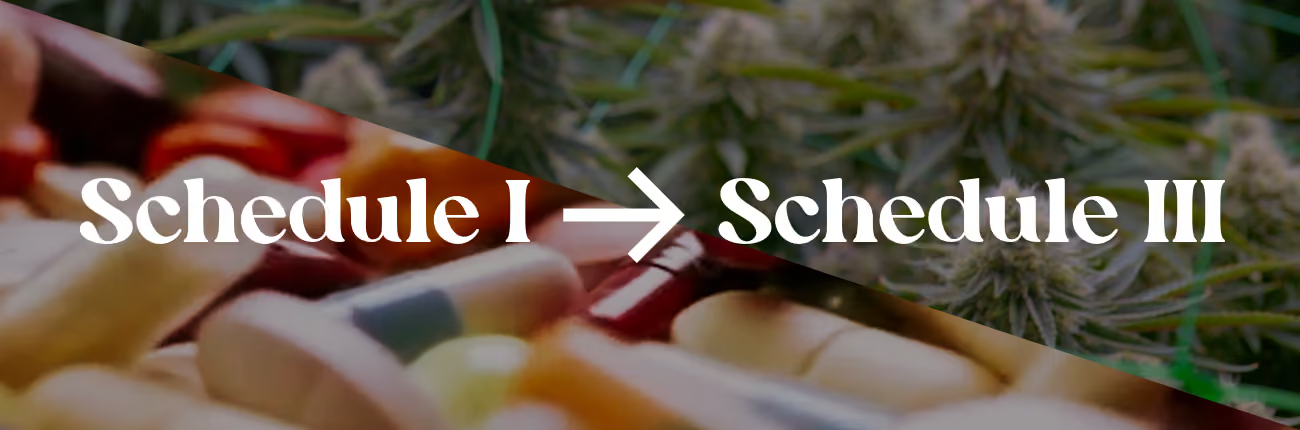
Schedule I is the most restrictive — for drugs the government says have no medical use and are highly addictive. Heroin is here. Until April 28, 2026, cannabis was classified the same way as heroin, even though that makes no sense to most people.
Schedule III is for drugs with accepted medical uses. Think prescription painkillers, like Tylenol with codeine. These drugs can help people but can also be abused, so the government monitors them.
By moving state-licensed medical marijuana to Schedule III, the federal government is acknowledging: "We admit cannabis has medical value. We see that it helps patients." That's significant after 54 years of treating it like heroin. But it doesn't automatically change everything overnight.
The National Landscape: Where Cannabis Stands Across America
As of June 2026: 40 states plus Washington D.C., Puerto Rico, Guam, and the U.S. Virgin Islands have legalized medical marijuana. 24 states plus Washington D.C. allow recreational cannabis for adults 21+. Only 10 states fully prohibit cannabis.
What this means: Most of America now recognizes cannabis has medical value. Arkansas is one of 40 states with medical programs — we're part of the mainstream, not an outlier. The rescheduling is the federal government finally catching up to what most states already decided.
What Rescheduling Doesn't Do
Let's be clear about the limits of this change.
It doesn't create federal legalization.
State-regulated medical marijuana is now federally acknowledged as legitimate, but it's not federally legal the way FDA-approved prescription drugs are. Medical operators and patients are still operating in a federal gray area.
It doesn't solve banking access problems.
Banks still face federal constraints on serving cannabis businesses. Rescheduling helps the policy argument, but it doesn't unlock institutional banking for operators.
It doesn't change FDA requirements.
Only FDA-approved cannabis drugs (like Epidiolex and Marinol) can be prescribed by doctors and transported across state lines like pharmaceuticals. Dispensary products remain unapproved under federal law and cannot move across state lines — yet.
It doesn't help recreational operators.
Recreational cannabis stays Schedule I, so the punishing federal tax rules (Section 280E) still apply to that sector.
It doesn't expunge criminal records.
Past cannabis convictions remain on the books.
Arkansas's Unexpected Advantage and the Risk That Comes With It
Here's something most national coverage isn't talking about: Arkansas's medical-only status may actually be a strategic advantage as interstate commerce comes into view.
Our CEO, Amanda Strickland, laid out the theory in MJBiz Daily: operators in states with both medical and adult-use licenses may need to split those licenses before they can register with the DEA and begin shipping products across state lines. Arkansas, as a medical-only state, wouldn't face that same administrative hurdle. "Arkansas has such an opportunity," Strickland told MJBiz Daily.
We're already seeing early signs at our dispensary. The Source typically sees about 10 new patients a day — a figure that has ticked up to 12 and sometimes 14 since rescheduling was announced.
But the opportunity comes with a real threat. Large multistate operators (MSOs) are already positioning for interstate commerce, and they have the legal teams and lobbying power to move fast. As Strickland put it in MJBiz Daily, "It's a chess game right now. The people that are playing chess, they are playing for interstate commerce."
The concern isn't abstract: each of the two Missouri dispensaries near the Arkansas state line does over twice The Source's revenue, and roughly 70% of their customers are Arkansans. If interstate commerce opens without state-level protections for Arkansas operators, larger out-of-state companies could flood the market here while our operators lack the scale to compete in theirs.
What's needed, Strickland said, is state legislation authorizing the governor to enter into interstate compacts — and independent operators cannot afford to wait while bigger companies plan for what comes next.
Read the full MJBiz Daily interview: "Can Arkansas' Small MMJ Operators Survive Interstate Commerce?"
The June 29 Hearing: What Comes Next
The DOJ announcement included something crucial: an expedited DEA hearing beginning June 29, 2026, and concluding by July 15, to consider broader rescheduling of cannabis — not just state-licensed medical programs, but recreational cannabis and broader marijuana products as well.
The hearing is a formal administrative process, and the outcomes are genuinely uncertain. Litigation is already being threatened by groups opposing broader rescheduling. If it passes, the landscape shifts dramatically. If it doesn't, only medical cannabis and FDA-approved products stay in Schedule III, and we're watching the same federal-state conflict play out in a different form.

Frequently Asked Questions
Does Schedule III mean cannabis is federally legal now?
No. Schedule III status means the federal government acknowledges medical value and lower abuse potential compared to Schedule I. But cannabis is still a controlled substance, still regulated by the DEA, and still prohibited under federal law for non-medical purposes. State-licensed medical cannabis operators are now in a federally acknowledged gray area with tax relief — not in a federally legal position.
What's happening at the June 29 DEA hearing?
The DEA will hold an administrative hearing beginning June 29 and concluding by July 15, to consider whether to reschedule marijuana as a whole — including recreational cannabis — from Schedule I to Schedule III. If it passes, the landscape shifts dramatically for the entire industry. Litigation challenges are likely.
Does rescheduling help with banking and investment?
Not directly. Schedule III status doesn't automatically open banking access. It's one piece of the puzzle, but federal banking regulations haven't changed, and most banks still won't serve cannabis businesses.
What about FDA-approved cannabis drugs like Epidiolex?
FDA-approved cannabis drugs are Schedule III under the new rules and can legally be transported across state lines as prescription medications. But most state-dispensary cannabis products are not FDA-approved and cannot move across state lines — yet.
One Step Forward
The rescheduling of state-licensed medical marijuana to Schedule III is real and meaningful. Federal policy is finally catching up to the reality on the ground: cannabis has medical value, and state-regulated programs — like those we operate under here in Arkansas — can operate safely.
But the next moves matter enormously, for patients, for independent operators, and for the future of Arkansas's program. We're watching closely. One step forward. More work ahead.
About The Source Cannabis Dispensary and Apothecary in Northwest Arkansas
The Source Dispensary and Apothecary is a locally owned craft medical marijuana company located in Rogers, Arkansas, just off Exit 85 on Interstate 49. With its own boutique grow, lab, and kitchen, The Source produces and distributes its own unique products while also stocking the highest quality offerings from Arkansas's great cultivators. We value friendliness, education, quality, and inclusivity — making us a true destination dispensary serving patients in Rogers, Bentonville, Fayetteville, Springdale, and the greater Northwest Arkansas area. Visit us to explore Arkansas-grown craft cannabis flower, edibles, concentrates, vapes, and more. All Arkansas MMJ cardholders welcome!

%201%20(1).avif)


